
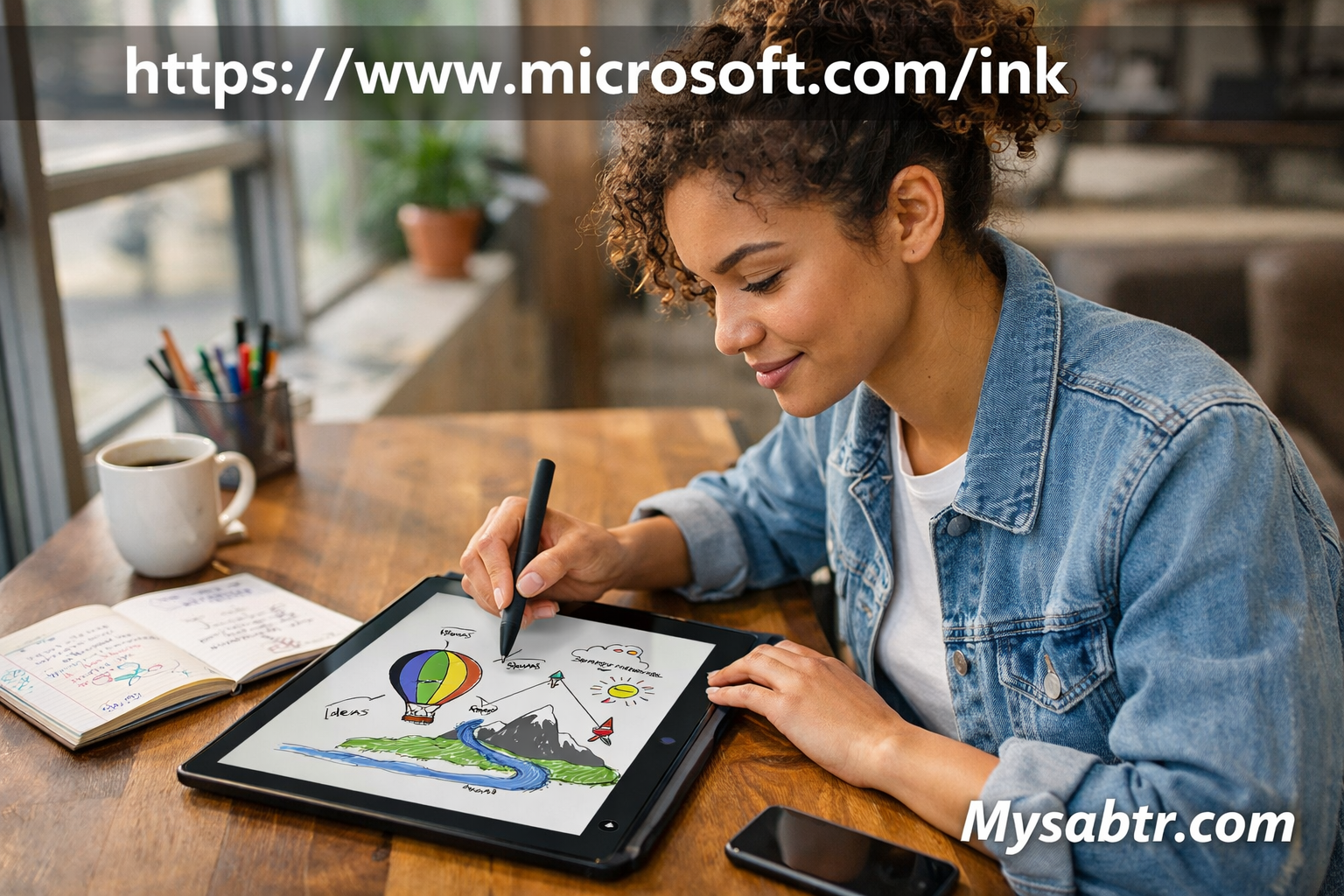
Our interaction with digital devices continues to evolve. Historically, keyboards and mice were the most popular methods of input. As technology has become more ingrained in our professional and creative lives, we have a growing need for intuitive and natural tools. This is where https //www.microsoft.com /ink comes in, filling the gap between analog comfort and digital capabilities. This is a major shift that transforms touch-enabled displays from simple screens into dynamic canvases for ideas, creations, and notes. It’s more than a simple feature. This is a platform that makes digital interactions feel human.
What is https //www.microsoft.com /ink?
The core of https //www.microsoft.com /ink is the technology framework that has been built into Windows to enable digital inking. You can write and draw on your tablet or phone using a digital pen, stylus, or your finger. It is not an application, but rather the foundation of Windows, which works with a variety of software. The system captures all the subtleties of pen strokes, including pressure, speed, and angle. This creates a remarkable writing and drawing experience. The digital ink allows for manipulations that would be impossible using traditional ink. The digital ink can be edited and manipulated. It can also be resized or resized.
It is a deep integration. Windows Ink Workspace is a dedicated workspace that includes the functionality of flagship Microsoft applications like OneNote and Word. The workspace gives you quick access to Sticky Notes (for quick notes), Sketchpad (for free-form drawings), and Screen Sketch, which allows annotations on screenshots. Inking should be an easy and immediate action. This will eliminate the need to open multiple apps to record a quick thought. Microsoft created an intuitive tool for both beginners and professionals by making digital ink part of their user interface.
Handwriting recognition, combined with AI and sophisticated intelligence is what makes https //www.microsoft.com /ink so powerful. The technology is able to convert handwritten text into searchable, easy-to-share text. This technology can recognize shapes drawn by hand and clean them into geometrically perfect forms. It is very useful for diagrams and flowcharts. It works in the background and allows you to remain in your creative flow, without having to change modes or tools. With natural gestures, you can circle or scratch out text to select the block. The combination of a natural user interface and intelligent processing makes https //www.microsoft.com /ink an incredibly transformative tool.
The Key Features of https //www.microsoft.com /ink
This is due to a combination of features that work in harmony and create an intuitive user interface. They go beyond drawing and turn your digital pen into a versatile tool that can be used for many different tasks. These tools are intuitive and use AI to keep your focus on work. These features allow you to create and communicate in digital spaces. They can convert messy handwriting to clean text or even precise diagrams.
The advanced conversion of handwriting to text is a cornerstone. You can write into any Windows 11 text box, from the search bar of a browser to an entire document within Microsoft Word. The system analyses your writing and converts it instantly into characters. It is especially useful for users of tablet devices and 2-in-1s, since it removes the necessity to switch constantly between a stylus or keyboard. This feature uses AI that is advanced enough to recognize even the messiest of handwriting. It makes it feel more natural. Shell Handwriting is a feature that demonstrates Microsoft’s commitment to make https //www.microsoft.com /ink the primary method for input in all operating systems.
Shape recognition is another feature that stands out. It can be difficult to create perfect squares and circles when drawing a mind map or flowchart. This is addressed by https //www.microsoft.com /ink, which recognizes the shapes that you draw automatically and converts them to clean digital versions. Instant refinement can save time while improving the quality of visual notes or presentations. Combining this tool with other tools, such as the digital ruler in PowerPoint applications, allows you to reach a degree of precision previously impossible without design software. It is now easier than ever to produce professional diagrams and other visual aids.
The https //www.microsoft.com /ink interface also includes annotating tools. One of the most useful applications is its ability to directly markup documents, images, or presentations. It is possible to highlight key passages within a Word or PDF document, to add comments in handwriting, and to draw attention to certain elements of a screenshot. It is very useful when you want to give feedback or collaborate on a project. Screen Sketch, for instance, lets you take a screenshot of the entire screen and then immediately begin drawing. The annotations are then saved and can be shared. This provides a clear context of communication, which is more effective than an email or a typed comment.
Useful Applications for https //www.microsoft.com /ink
Its adaptability and versatility are demonstrated by the many practical applications of https //www.microsoft.com /ink. The intuitiveness of the software makes it an asset for education, creative, and business industries, as well as everyday personal organizing. It helps the user think visually and to capture their ideas in a spontaneous way.
Digital inking has transformed the educational experience of both teachers and students. OneNote allows students to take notes by hand, including diagrams, equations, and text, all on one page that can be scrolled infinitely. Typing alone is not always the best way to improve comprehension. In a digital format, they can organize study materials, solve math problems, and annotate materials. Teachers can use https //www.microsoft.com /ink to create engaging lesson plans and annotate student work. They can also explain complex concepts in a visual way during presentations.
The business world uses https //www.microsoft.com /ink to streamline communication and increase productivity in meetings and collaboration sessions. It can be used to review designs with handwritten comments, brainstorm on the Microsoft Whiteboard, and markup contracts. Team members don’t need to take notes separately in separate notebooks. They can add their contributions in real time. A speaker can draw directly on the slides during a presentation to emphasize key points. This will engage and excite an audience. The ability to share information in a contextually clear and concise manner and to visualize ideas helps improve teamwork and accelerates decision-making.
Designers, artists and other creative professionals can use https //www.microsoft.com /ink as a responsive and fluid medium to sketch and generate ideas. Modern styluses, such as those on the Surface series of devices, offer a drawing experience similar to traditional tools. The Surface line allows artists to sketch out initial ideas, then refine them with digital tools and layers. They can also seamlessly move their work from the device into more powerful software. The integration of natural drawing with the flexibility and speed of digital workflows allows greater creativity. This bridges the gap from the spark of an original idea to its execution.
Devices and Tools Supporting https //www.microsoft.com /ink
Hardware that is capable of supporting https //www.microsoft.com /ink will have a major impact on its effectiveness. Windows has the capability to use pen input, but the best user experience comes from devices that are designed for this purpose. They often have high-resolution screens, palm rejection technologies, and styluses designed to provide a smooth inking experience.
Microsoft’s Surface devices are the best showcase of the abilities of https //www.microsoft.com /ink. Surface Pro, Surface Laptop Studio, and Surface Go were designed from the start for pen interaction. PixelSense displays are calibrated to ensure accuracy and responsiveness. Surface Pen, which is part of the ecosystem, offers features such as pressure sensitivity and tilt support to shade. It also has a button that can be programmed for easy access to various tools. The Surface Slim Pen is one of the latest models that includes haptic feedback, which simulates the feel of writing on paper, and magnetic charging.
A growing number of Windows 2-in-1 convertible laptops and tablets, from manufacturers other than Microsoft Surface provide great support for https //www.microsoft.com /ink. Dell, HP, and Lenovo all offer devices with touch-sensitive displays and active styluses. The wide range of hardware options available gives users a variety of choices, which they can tailor to their needs and budget. Look for a screen with an active digitizer, which will allow you to input your pen precisely, as well as palm rejection. This feature allows you to write on the screen without leaving unwanted marks.
It is important to have a ecosystem that supports https //www.microsoft.com /ink. Windows Ink Workspace is a great foundation, but the real power lies in applications with deeply integrated features. Microsoft OneNote, which is an all-in-one digital notebook, may be the most popular app to use for inking. Microsoft Word and PowerPoint both allow you to edit and annotate documents with a stylus. Microsoft Whiteboard is a canvas that can be used for collaborative brainstorming. Many third-party Microsoft Store applications, especially those focusing on design and art, like Adobe Fresco and Sketchbook, leverage Windows Ink to offer a rich, responsive experience.
Use https //www.microsoft.com /ink to Get Tangible Benefits
The adoption of https //www.microsoft.com /ink in a daily workflow offers tangible benefits to enhance creativity, boost collaboration, and increase overall efficiency. The benefits stem from the fact that it allows for a natural, direct way to interact with digital content. It goes beyond keyboards and mice. Platforms help to reduce the barrier of technology and make it feel more like an extension.
The enhancement of brainstorming and creativity is one of the greatest benefits. Writing and drawing with our hands is directly linked to the way we process information. The https //www.microsoft.com /ink allows users to freely sketch, doodle, and write on a canvas digitally, which facilitates an organic way of ideation. It can help to generate more creative solutions and allow for a better visualization of complicated concepts. Inking canvases, such as those in OneNote and Whiteboard, are non-linear, which encourages association. This allows for ideas to be connected in a way that is not possible with a typed or structured document.
The use of https //www.microsoft.com /ink also improves collaboration. Communication becomes personal and direct when team members are able to mark up shared documents, diagrams, or presentations with their handwriting. It is easier and faster to give visual feedback than to type comments. An arrow or circle drawn around a problematic area can be more effective than a long sentence. Visual and contextual communication can reduce misunderstandings and help teams iterate ideas faster.
Finaly, https //www.microsoft.com /ink helps to increase efficiency and productivity. It is possible to save time by quickly writing a message on a Sticky Note or signing a document without having it printed. The ability to quickly delete a word by simply striking it through eliminates the need to change tools. This helps maintain focus. For those who are visual learners or problem solvers, using handwritten lists and mind maps can help them plan and organize their thoughts more effectively. It makes the daily chores feel easier and more personalized.
Real-World Examples in Action using https //www.microsoft.com /ink
It is easiest to understand the practical benefits of https //www.microsoft.com /ink by looking at real-world examples where it solves everyday problems or streamlines complex tasks. The examples above show that digital inking can be a useful tool for a variety of professions, as well as personal pursuits.
Imagine that you are a student attending a lecture at a university. Surface Pro and OneNote allow students to take notes on the lecture using their Surface Pro instead of a word processing program. The tools provided by https //www.microsoft.com /ink allow them to record audio from the lecture and synchronize it with the handwritten notes. The student can draw a diagram on the paper and annotate it in various colors as the professor is explaining a complex concept. This technology, https //www.microsoft.com /ink, allows the student to pause the lecture, add annotations, or sketch if necessary, directly onto the page. When studying later, the student can tap a particular part of the notes and have the audio jump directly to that moment. The combination of drawings and audio provides a multi-modal, rich study guide. It is more efficient than just typing out a document.
Imagine a manager of a website project leading a meeting with a group to discuss a redesign. To facilitate feedback, the design mockup appears on a big screen. The manager then uses the Whiteboard App to use https //www.microsoft.com /ink. The manager can use a stylus as team members make suggestions to highlight elements and write directly on the mockup. Arrows are also used to show proposed changes. The developer can also use https //www.microsoft.com /ink to pull up the whiteboard from their device and make technical comments or draw out an alternate layout. This feedback can all be captured in a shared canvas, which is easily saved for later reference. The visual, interactive approach ensures everyone’s on the same page. All feedback will be captured correctly and in context.
Imagine an architect on a building site. The architect uses a ruggedized Windows Tablet to view digital blueprints. They notice that the blueprint and actual construction differ. They can use the stylus instead of a piece of paper that may get damaged or lost to make a note. The cloud instantly syncs the annotated plan, making it available for the engineers back in the office. The seamless transfer of data from the field back to the office speeds up problem-solving and minimizes costly mistakes.
The Evolving Future of https //www.microsoft.com /ink
Digital inking’s journey is not over. The capabilities and integrations of platforms such as https //www.microsoft.com /ink will become more advanced and vital to our digital life, especially with the advancement of technology. Improvements in AI, hardware, and software integration will likely lead to a future where the lines between digital and physical creation are blurred even more. Digital inking will become predictive, collaborative, and context-aware.
In the future, AI developments will make it possible to recognize handwriting in almost any style. It could suggest that a list of scribbled notes be converted into a task list for a project manager app, or that a flowchart sketched out becomes an interactive diagram. AI can also be used to enable a more sophisticated semantic understanding whereby the system understands not just the meaning of the words that you type, but the actual context in which they are written. Writing “Schedule an appointment with Sarah next Tuesday” would automatically create a calendar with all the details, including contact information and time.
The goal of digital inking is to make it so intuitive and seamless that we feel like our minds are being extended. The technology will become less important, and the focus will be more on the thoughts we can express. Digital inking will be a future where the technology is completely adapted to our creativity. It provides an intuitive, boundless canvas that allows for collaboration and innovation. The foundation of this journey is https //www.microsoft.com /ink, which is constantly pushing the limits of what’s possible by combining the timeless act of writing with the unlimited potential of the digital world.
Hardware advances will be crucial. Styluses with a more refined haptic response, capable of simulating different writing surfaces such as canvas or parchment, are on the horizon. The screens may be able to provide different textures for a better writing experience. The convenience of having a digital notebook to store all your ideas and work will increase as devices get lighter, faster, and more battery-efficient. Inking combined with virtual and augmented reality may also offer new opportunities, such as the ability to draw and write in 3D space.
The goal of digital inking is to make it so intuitive and seamless that we feel like our minds are being extended. The technology will become less important, and the focus will be more on the thoughts we can express. Digital inking will be a future where the technology is completely adapted to our creativity. It provides an intuitive, boundless canvas that allows for collaboration and innovation. The foundation of this journey is https //www.microsoft.com /ink, which is constantly pushing the limits of what’s possible by combining the timeless act of writing with the unlimited potential of the digital world.
The goal of digital inking is to make it so intuitive and seamless that we feel like our minds are being extended. The technology will become less important and the focus more on the thoughts we can express. Digital inking will be a future where the technology is completely adapted to our creativity. It provides an intuitive, boundless canvas that allows for collaboration and innovation. The foundation of this journey is https //www.microsoft.com /ink, which is constantly pushing the limits of what’s possible by combining the timeless act of writing with the unlimited potential of the digital world.
Conclusion of https //www.microsoft.com /ink
Microsoft https //www.microsoft.com /ink is a testimony to the notion that technology should be adapted to humans, and not vice versa. It has transformed the way we think about creativity, productivity, and collaboration by integrating writing and drawing, which is a natural, intuitive activity. The technology transforms devices into active canvases that allow users to communicate more effectively, capture and store ideas, and work faster. Digital inking is a powerful tool that can be used anywhere, from the boardroom to classrooms, or even at home. This technology will continue to develop and play a more important role as it bridges the gap between digital thought and human expression.